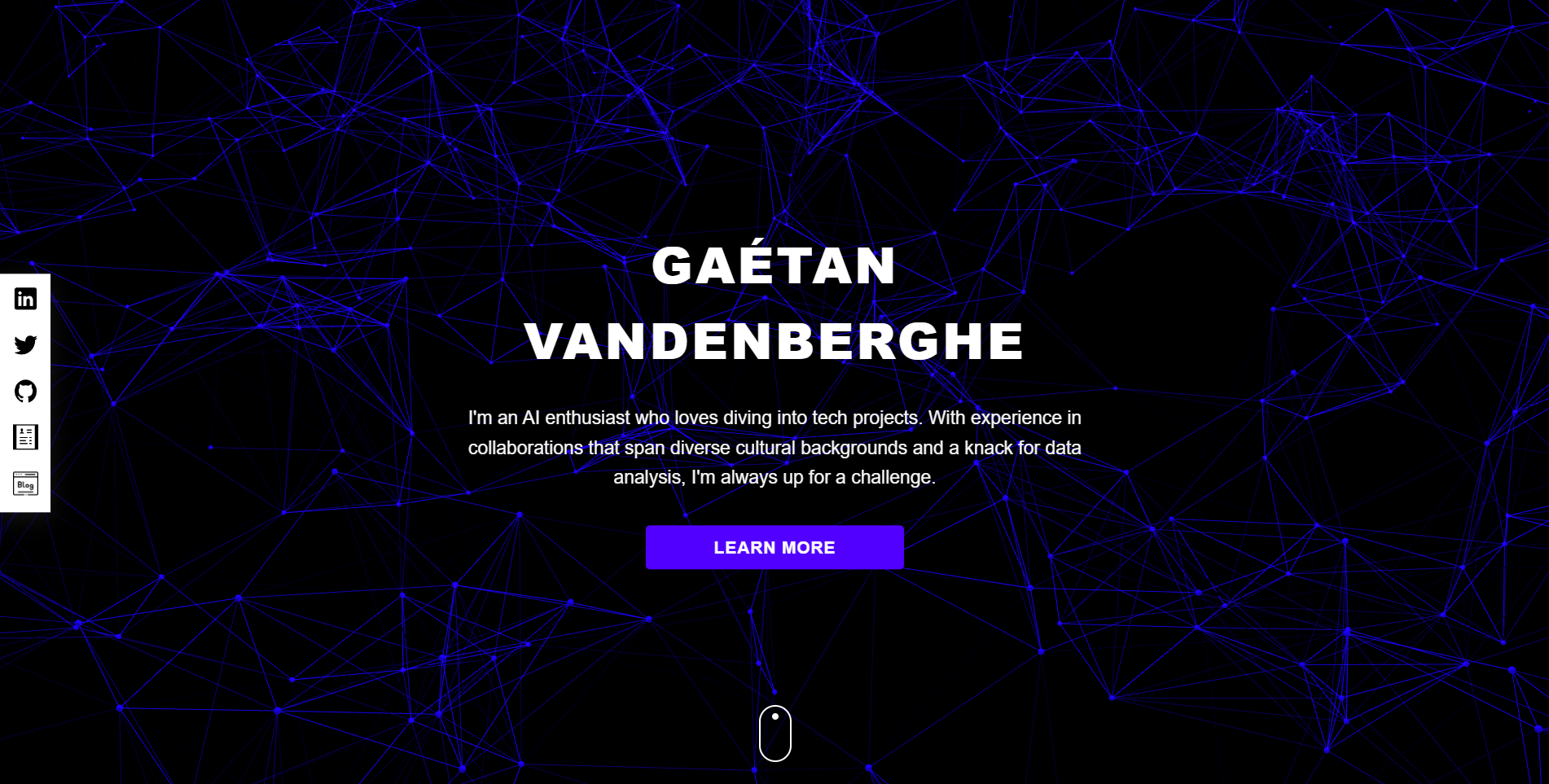
I started the project to practise web development. I finished it with a better understanding of how design, engineering and professional storytelling depend on one another.
After my second year studying artificial intelligence, I wanted a place that brought my projects, skills, writing and contact information together. Existing profiles could list those things, but they could not express the relationships between them or the direction I wanted to take.
Building the first version
I used HTML, CSS and JavaScript, with Git and GitHub Pages for version control and hosting. The technical choices were intentionally accessible. The goal was to learn by owning the full page, from structure and responsive layout to deployment and iteration.
The first site included sections for skills, projects, contact information, articles, my CV and a short introduction. Building each section exposed a different problem. Project cards needed hierarchy. Contact links needed clarity. Long-form writing needed readable typography. Mobile layouts needed more than a smaller desktop design.
The hardest part was not writing the code. It was deciding what deserved attention and explaining it without making the visitor work for the meaning.
A portfolio is a product
The site had a specific audience and a specific job. It needed to help recruiters, collaborators and other developers understand my interests quickly. That meant treating it like a product: define the audience, prioritise information, reduce friction and test the result.
I also learned that every design decision communicates something. Typography sets the tone. Motion can create focus or distraction. A vague project description can undermine technically strong work. Good presentation does not replace substance, but it helps the substance become visible.
Why the work continues
A personal site is never completely finished because the person behind it keeps changing. New projects replace older ones. Writing becomes more precise. The visual system matures. That is not a flaw; it is the reason the site remains useful.
This first version gave me a public record of my progress and a place to experiment. More importantly, it taught me to evaluate my own work from a visitor's perspective. The portfolio you are reading now is another step in that same process.