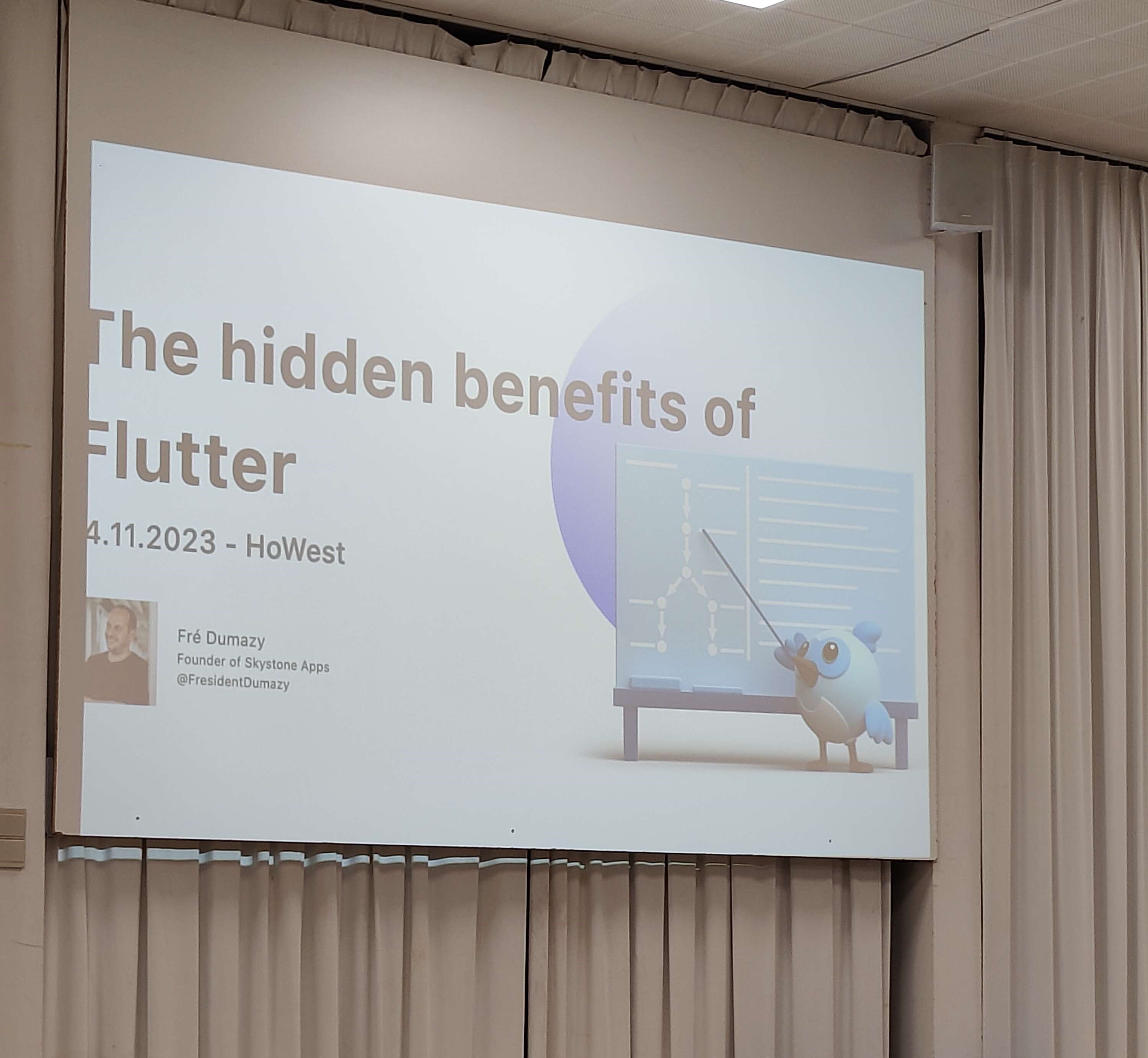
The most obvious promise of Flutter is one codebase for several platforms. The more interesting benefit is how that shared foundation improves the development workflow.
During a Howest tech immersion, Fré Dumazy demonstrated how Flutter and Dart can target mobile, web and other device categories while preserving a consistent interface model. The session made the framework feel less like a shortcut and more like a deliberate product-engineering choice.
A unified way to build interfaces
Flutter renders its own widget system instead of assembling a different set of native interface components on every platform. That gives developers detailed control over layout, motion and visual behaviour. It also reduces the small inconsistencies that often appear when separate implementations evolve in parallel.
The trade-off is responsibility. A consistent rendering layer does not remove the need to respect platform conventions, accessibility expectations or device constraints. Shared code works best when the experience still feels appropriate wherever it runs.
A faster feedback loop
Stateful hot reload was the clearest productivity gain in the demonstration. A developer can change code and see the result without repeatedly rebuilding the application or recreating the current screen state. That makes visual tuning and small behavioural experiments far less disruptive.
The value of hot reload is not simply speed. It encourages smaller experiments, quicker validation and tighter collaboration between design and engineering.
Performance without separate products
Flutter compiles for its target platforms and is designed for smooth, responsive interfaces. For many products, that creates a useful middle ground: one primary codebase without making the application feel like a thin wrapper around a website.
The surrounding ecosystem matters too. Strong documentation, testing support and an active open-source community reduce the friction of adopting the framework. Teams can spend more time on product decisions and less time assembling basic tooling.
The decision is still contextual
Flutter is not automatically the best answer for every application. Teams should consider native integrations, existing expertise, long-term maintenance and the importance of platform-specific behaviour. Still, the session showed why Flutter deserves consideration: it offers a coherent way to design, build and refine experiences across platforms without splitting the product into separate engineering efforts.